
What Are the Fastest Ways to Clear Your BI Backlog?
At a glance
Discover effective strategies to clear your BI backlog with AI, prioritization frameworks, and semantic layers for faster insights.
The fastest way to clear your BI backlog combines ruthless prioritization using frameworks like RICE or MoSCoW, AI-powered triage that can reduce time-to-market by 30%, and implementing a semantic layer that prevents duplicate requests. Organizations applying these methods report dramatic results, including 88% reduction in manual effort and 45% faster decision-making.
Key Facts
• Technical debt consumes 33% of developer time, directly contributing to growing backlogs and delayed BI requests
• Inconsistent data definitions cost businesses 12-15% of annual revenue through duplicated work and conflicting reports
• AI-driven prioritization enables 30% faster time-to-market by automating dependency mapping and effort estimation
• Implementing semantic layers eliminates redundant rework across BI tools, providing single source of truth for metric definitions
• Healthcare organizations achieved 45% faster provider decisions and 88% reduction in manual reporting after implementing AI-powered analytics
• Self-service analytics with natural language queries allows business users to answer questions independently, preventing new backlog items
If you run a data team at a growing organization, you know the feeling: requests pile up faster than your analysts can clear them. Stakeholders wait days (or weeks) for answers. Metric definitions conflict. And everyone blames the backlog.
The fastest path to clearing your BI backlog isn't hiring more analysts or working longer hours. It's a combination of ruthless prioritization, AI-powered triage, and a governed semantic layer that prevents duplicate requests from forming in the first place.
This guide walks through each lever in detail, with concrete frameworks, tooling recommendations, and real-world results from healthcare and enterprise organizations. Understanding the role of a context layer as the foundation AI data agents need helps explain why these approaches work.
Why Do BI Backlogs Explode – and Why Does Speed Matter?
BI backlogs rarely grow because teams are lazy. They grow because of systemic pressures that compound over time.
Backlogs aren't just messy-they're momentum killers, as one Dart AI analysis puts it. And the underlying causes are predictable:
-
Technical debt accumulation: Developers spend on average 33 percent of their time dealing with the consequences of technical debt, according to Slack's productivity research. That's time not spent on new requests.
-
Inconsistent data definitions: When finance calculates revenue differently than sales, every report spawns follow-up questions. TDWI estimates that inconsistent or inaccurate data costs corporations up to $3 trillion annually, with individual businesses losing 12 to 15 percent of annual revenue.
-
Fragmented governance: Without clear ownership of metrics and definitions, ad-hoc requests multiply. Each team builds their own version of "monthly active users" or "customer churn," and the data team gets pulled into reconciliation work.
The cost of delay isn't just frustration. Slow answers mean missed market opportunities, delayed product decisions, and eroding trust between business and data teams. Speed matters because every day a request sits in the backlog is a day someone makes a decision without data, or worse, with the wrong data.

How Do You Prioritize BI Requests Ruthlessly?
The fastest way to shrink a backlog is to stop working on low-value requests. That sounds obvious, but most teams lack a systematic way to score incoming work.
Here are the frameworks that actually work, based on Milestone AI's prioritization research:
| Framework | How It Works | Best For |
|---|---|---|
| MoSCoW | Categorizes items as Must have, Should have, Could have, Won't have | Tight deadlines, quick alignment |
| RICE | Scores by Reach × Impact × Confidence ÷ Effort | Data-driven teams with usage metrics |
| WSJF | Cost of Delay ÷ Job Duration | Organizations using SAFe or Agile at scale |
| Kano Model | Classifies features into Must-have, Performance, Delighters | User-centric prioritization |
| Value vs. Effort Matrix | Maps tasks by benefit and required effort | Visual, collaborative sessions |
The Kano model is particularly useful for BI teams because it forces you to ask: "Will this request delight stakeholders, or is it just expected?" Features that users expect but don't explicitly value (like fixing a broken filter) often need to jump the queue, while "nice to have" dashboards can wait.
Practical implementation steps:
-
Score every incoming request using one framework consistently. RICE works well for most BI teams because you can estimate reach (how many people use this report), impact (how much it influences decisions), confidence (how sure are you about the estimates), and effort (analyst-hours required).
-
Review scores weekly with stakeholders. Transparency reduces the "my request is most important" conversations.
-
Kill requests aggressively. If something has sat in the backlog for three months without movement, ask whether it's still needed. Often it isn't.
Key takeaway: Prioritization frameworks only work if you actually use them to say no. A scored backlog that never gets trimmed is just a longer list.
Can AI Automate Backlog Triage?
Yes, and the results are significant. Organizations implementing AI-driven prioritization report up to 30% faster time-to-market and higher stakeholder satisfaction scores.
AI helps with backlog management in several ways:
-
Automated dependency mapping: Jira's AI can analyze project data and suggest backlog items that align with sprint goals. Teams leveraging AI for dependency mapping report 40% fewer unexpected blockers.
-
Pattern recognition across requests: AI excels at pulling in diverse data sources and synthesizing them into a single decision-making layer. It can detect when multiple stakeholders are asking for the same underlying insight in different ways.
-
Effort estimation: Historical data on similar requests helps AI predict how long new items will take, improving sprint planning accuracy.
-
Priority scoring: AI can apply frameworks like RICE automatically, flagging requests that score high but haven't been assigned.
The key is keeping humans in the loop. AI triage works best when it surfaces recommendations that analysts then validate. Fully automated prioritization tends to miss context that only experienced team members understand.
Tools worth evaluating include Jira (with AI features enabled), Productboard for product-focused teams, and general-purpose AI assistants that can integrate with your project management stack.
How Does a Semantic Layer Stop Backlogs at the Source?
Many BI requests aren't actually new questions. They're variations on the same question, asked because stakeholders don't trust existing reports or can't find them.
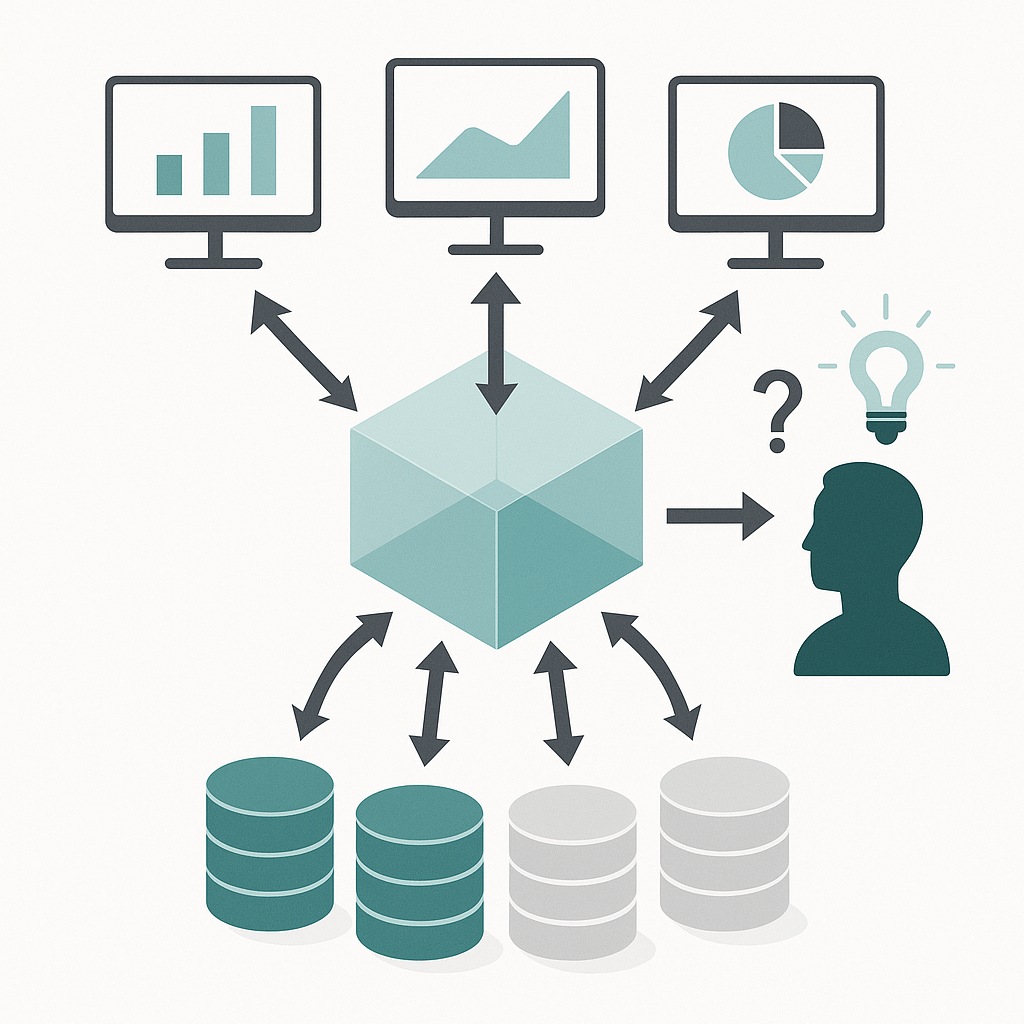
A semantic layer addresses this root cause. As IntuitionLabs defines it, a semantic layer is "an abstraction layer that translates complex data into business-friendly terms and unified metrics, effectively bridging raw data sources and analytics/BI tools."
Here's how it prevents backlog growth:
-
Single source of truth: A universal semantic layer eliminates costly and redundant re-work across BI tools. When everyone queries the same metric definitions, you don't get three versions of "revenue" floating around.
-
Self-documentation: "Instead of writing complex SQL queries to calculate revenue, churn, or average order value every time, you define those calculations once, in the semantic layer." Business users can discover existing metrics before requesting new ones.
-
Reduced metric disputes: When the CFO and VP of Sales disagree about a number, the semantic layer shows exactly how it was calculated. No more "your data is wrong" tickets.
-
AI-readiness: Semantic layers make AI in business analytics more accurate and explainable because the AI queries governed definitions rather than raw tables.
Popular semantic layer tools include dbt Metrics Layer, Cube.dev, Looker (LookML), AtScale, and Power BI Semantic Models. The right choice depends on your existing stack and team capabilities.
Key takeaway: A semantic layer doesn't just organize data-it prevents the request cycles that create backlogs in the first place. For a deeper dive into semantic layer options, see our best semantic layer solutions for data teams 2026 guide.
Give Business Users Safe Self-Service Analytics
The ultimate backlog reduction strategy is enabling business users to answer their own questions without flooding the data team.
This requires tools that are both powerful and safe. ThoughtSpot empowers users with enterprise-grade AI that makes it easy for everyone to explore data in real-time. The self-service experience makes data exploration intuitive even for those without a technical background.
Key capabilities to look for:
-
Natural language queries: SAP Analytics Cloud and similar platforms let business users "get instant and accurate answers about their data by asking questions using natural language." No SQL required.
-
Governed guardrails: Self-service doesn't mean ungoverned. The best tools apply security controls, row-level permissions, and metric definitions automatically.
-
Transparency: Users should see how any number was calculated. This builds trust and reduces "why is this different from my spreadsheet" follow-ups.
The results can be dramatic. One healthcare organization saw an 88% reduction in manual effort spent searching for reports and creating narratives after implementing an AI-powered analytics assistant.
Self-service works best when paired with a strong semantic layer. Business users can only trust their own queries if the underlying definitions are governed and consistent.
Real-World Wins: Healthcare Orgs Slashed Backlogs in Months
These frameworks aren't theoretical. Large enterprises have applied them with measurable results.
Cognizant healthcare case study: A U.S.-based healthcare company implemented an AI-powered virtual assistant called RESOLV for revenue cycle management. Results included:
- Provider decisions 45% faster
- ~30% increase in operational processing with sustained information accuracy
- 88% reduction in manual reporting effort
Nsight healthcare BI implementation: A major American healthcare institution with over 900 board-certified physicians worked with Nsight to implement Business Intelligence solutions. The engagement enhanced efficiency, data security, governance, and customer satisfaction while lowering Total Cost of Ownership.
CBI Health infrastructure modernization: This Canadian healthcare provider migrated 500+ servers in just three months using AWS Experience-Based Acceleration. The result: 60% cost savings on infrastructure and 75% reduction in technology footprint. While not a pure BI project, it demonstrates how modernization enables faster analytics delivery.
The common thread across these cases: combining technology (AI, semantic layers, modern infrastructure) with process changes (prioritization frameworks, governance models) delivers compounding benefits.
Clearing Your BI Backlog – for Good
Backlog reduction isn't a one-time project. It's an operating model.
The organizations that maintain clear backlogs long-term do three things consistently:
-
Prioritize ruthlessly using a consistent framework. Requests that don't drive measurable value get deprioritized or killed.
-
Automate triage with AI tools that surface patterns, map dependencies, and estimate effort. This frees analysts to focus on high-value work.
-
Prevent request sprawl with a governed semantic layer that provides one source of truth. When stakeholders can trust existing metrics, they stop requesting duplicates.
Kaelio integrates data across EHRs, finance systems, staffing schedules, claims platforms, and more-providing the semantic layer and AI capabilities that enterprise data teams need. The platform helps billing teams and operations leaders respond before small issues become major losses, turning raw data into governed, queryable insights that business users can access without SQL skills or BI training.
If your backlog has become a bottleneck, start with prioritization. Score your existing requests, kill the ones that don't matter, and build the infrastructure that prevents the cycle from repeating. For a full comparison of AI analytics platforms that can help, see our best AI data analytics tools 2026 guide.
How Kaelio Is Positioned Today
Kaelio's Data Agent is the product business teams interact with day to day. It uses ktx in the background to answer analytical questions in plain English, ground every answer in governed business context, and deliver accurate, governed analytics without replacing your warehouse, BI, or transformation tools.
Behind it, ktx builds the governed context layer from your data stack, combining schema, lineage, semantic models, dashboard logic, and domain knowledge into a source of truth that can also be exposed to MCP-compatible agents.
FAQ
What causes BI backlogs to grow?
BI backlogs often grow due to systemic pressures like technical debt, inconsistent data definitions, and fragmented governance, which lead to delays and inefficiencies.
How can AI help in managing BI backlogs?
AI can automate backlog triage by mapping dependencies, recognizing patterns across requests, estimating effort, and applying priority scoring frameworks like RICE, thus speeding up the process.
What is a semantic layer and how does it help with BI backlogs?
A semantic layer is an abstraction that translates complex data into business-friendly terms, providing a single source of truth and reducing redundant requests by ensuring consistent metric definitions.
How can business users safely perform self-service analytics?
Business users can use tools with natural language queries and governed guardrails, allowing them to explore data safely and transparently without technical expertise, reducing the burden on data teams.
How does Kaelio help in reducing BI backlogs?
Kaelio integrates with existing data infrastructures to provide a governed semantic layer and AI capabilities, enabling faster, accurate insights and reducing the need for duplicate requests.
Sources
- https://www.dartai.com/blog/how-can-ai-help-with-backlog-management
- https://www.cognizant.com/us/en/case-studies/ai-healthcare-operations-intelligence
- https://slack.com/blog/productivity/agile-prioritization-techniques-that-boost-team-productivity
- https://tdwi.org/articles/2024/04/01/arch-all-how-universal-semantic-layer-enables-consistent-answers.aspx
- https://mstone.ai/glossary/backlog-prioritization
- https://www.figflow.io/resources/top-tools-for-ai-powered-backlog-creation-a-comprehensive-comparison
- https://www.productboard.com/blog/using-ai-for-product-roadmap-prioritization/
- https://intuitionlabs.ai/pdfs/what-is-a-semantic-layer-a-guide-to-unified-data-models.pdf
- https://www.linkedin.com/pulse/rise-semantic-layers-bi-simplifying-data-access-everyone-ejike-zfyqf
- https://www.thoughtspot.com/data-trends/articial-intelligence/ai-analytics-tools
- https://www.sap.com/products/data-cloud/cloud-analytics/features.html
- https://www.nsight-inc.com/nsight-resources/business-intelligence-solution-to-transform-data-into-meaningful-insights/
- https://aws.amazon.com/solutions/case-studies/cbi-health-case-study